by Ashley Purcher – Physiotherapist
Your ankle plays an important role in everyday movements such as walking, running, squatting, climbing stairs and playing sports. It needs to move freely to allow your body to move comfortably and efficiently. However, following an injury or a period of reduced activity, you may notice that your ankle feels stiff, tight or restricted.
You might find it difficult to bring your knee forwards over your toes, struggle to get into a deep squat, or experience a pinching sensation at the front of your ankle when bending it forwards. Sometimes, one ankle simply does not move as well as the other.
Ankle stiffness can develop for several reasons, including previous ankle sprains, tight calf muscles, restricted joint movement or irritation around the front of the ankle. Understanding what is causing your symptoms is important when deciding on the most appropriate treatment.
What causes ankle stiffness?
Previous ankle sprains
An ankle sprain can leave you with lingering swelling, reduced movement and a feeling that your ankle has never quite returned to normal. Even after the initial pain settles, you may find it difficult to bring your knee forwards over your toes or return to your usual exercise and sporting activities.
Tight calf muscles
Your calf muscles help control ankle movement. If they are tight or have lost some flexibility, you may struggle to bring your knee forwards while keeping your heel on the ground. This can affect activities such as squatting, lunging, walking uphill or downhill, and running.
Restricted ankle joint movement
Sometimes, the ankle joint itself does not move as freely as it should. This may leave you feeling as though your ankle is blocked or restricted when you try to bend it forwards. You might notice this during squats, lunges, stair climbing or other movements that require your knee to travel forwards over your toes.
How can physiotherapy help ankle stiffness?
A physio can assess your ankle movement, identify factors that may be contributing to your symptoms and develop a treatment plan suited to your needs.
Your assessment may include checking how far your knee can travel forwards over your toes, comparing both ankles, assessing your calf flexibility and strength, and observing movements such as squatting or stepping down. Your injury history, current symptoms and goals will also help guide your treatment.
Depending on the findings, treatment may include hands-on therapy, dry needling, mobility exercises and strengthening.
Hands-on treatment and ankle joint mobilisation
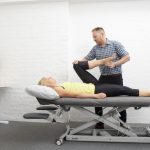
Ankle joint mobilisation involves your physio using specific, controlled movements to help free up the ankle joint and improve its movement. This may be useful if your ankle feels restricted when bringing your knee forwards over your toes.
The aim is to help your ankle move more comfortably and improve your ability to perform everyday activities and exercise.
Dry needling
Dry needling may be used to help address tightness in the muscles and surrounding soft tissues around your ankle and calf. It can help reduce muscle discomfort and improve comfort when moving your ankle.
Mobility exercises
Specific exercises can help improve ankle movement and make activities such as squatting, lunging and walking more comfortable. These may include calf stretches, controlled knee-to-wall movements or other exercises selected for your particular restriction.
The important thing is choosing the right exercise for your ankle. If you experience a sharp pinch at the front of your ankle, forcing the stretch is unlikely to be the answer.
Strengthening and rehabilitation
Mobility is only part of the picture. Your ankle also needs enough strength and control to cope with the demands of everyday life, exercise and sport.
Your physio may prescribe calf raises, resistance exercises and balance work. As your ankle improves, these exercises can progress towards more demanding activities such as running, jumping and changing direction.
The goal is not simply to improve your ankle movement during treatment, but to help you use that movement confidently in real life and reduce the likelihood of ongoing problems.

Ankle stiffness physiotherapy at Wisdom Physiotherapy
If your ankle has felt stiff for weeks or months, you keep experiencing a pinch at the front of your ankle, or you have never quite regained your movement after an ankle sprain, you do not have to keep guessing which stretches to try.
At Wisdom Physiotherapy, our physios can assess your ankle, identify factors contributing to your restricted movement and develop a treatment plan to help you improve your mobility and function.
If ankle stiffness is holding you back, call us today on (08) 9384 1555 to book an appointment and take the first step towards moving more comfortably and getting back to the activities you enjoy.